RESULTS LOG // HAIR-FOLLICLE LENS FIRST
KLOW Results in the Research Literature
Component findings only. KLOW peptide has not been tested as a blend. The results below are single-constituent data — attributed to the channel that produced them.
TL;DR
This page logs what the peer-reviewed studies actually measured for the four peptides in KLOW peptide. Hair-follicle results come first — that is the dominant lens for this channel. Then wound-repair, anti-inflammatory, and matrix data.
Two things to hold in mind: first, every result here is from a single-peptide study, not the KLOW blend. Second, most of the strongest data comes from animal models. Human studies are listed where they exist, but they are fewer. The TB-500 channel (thymosin beta-4 in the source studies) is the most-cited for follicle results; the GHK-Cu channel is the most-cited for matrix and skin. Read each result with its channel label — that tells you which of the four peptides produced it.
GHK-Cu channel: hair-follicle results
Copper-tripeptide complexes stimulate C3H follicle activity. Topical peptide-copper complexes — the GHK-Cu class — stimulated hair-follicle activity in C3H mice (Trachy 1991) [9]. The abstract is brief but the model and title are confirmed via PubMed (PMID 1809108).
AHK-Cu analog: elongation and anti-apoptotic effects in human follicles. The alanyl analog AHK-Cu (structurally closest to GHK-Cu in the copper-tripeptide family) at 10^-12 to 10^-9 M elongated human hair follicles ex vivo and promoted dermal papilla cell proliferation in vitro; at 10^-9 M it reduced apoptosis — elevated Bcl-2/Bax, lower cleaved caspase-3 and PARP [10]. This is the closest human ex-vivo copper-tripeptide follicle data in the literature. NOTE: tests AHK-Cu, not GHK-Cu; cite only as analog context.
GHK-Cu skin and matrix results (broader channel). Topical GHK-Cu increased collagen production in 70% of treated women vs 50% for vitamin C and 40% for retinoic acid; stimulates synthesis of collagen, dermatan sulfate, chondroitin sulfate and the proteoglycan decorin [4]. GHK modulates ~31% of human genes at a ≥50%-change threshold, with the strongest shifts toward matrix synthesis, DNA repair, and antioxidant programs [5]. These are matrix-channel results that underpin the follicle rationale: dermal matrix integrity is foundational to follicle anchoring and cycling.
2026 review. A 2026 Biomedicines review consolidates the multi-mechanism hair-growth rationale for short peptides including GHK-Cu [11].

TB-500 / thymosin beta-4 channel: hair-follicle stem-cell results
Bulge stem-cell activation. Thymosin beta-4 at nanomolar concentrations stimulated hair growth in normal rats and mice by activating hair-follicle bulge stem cells (the reservoir cells in the follicle base that initiate each new hair cycle), increasing their migration and differentiation, and elevating MMP-2 (matrix metalloproteinase-2, an enzyme that remodels the matrix around the follicle) expression (Philp 2004, FASEB J) [8].
Stem-cell migration and differentiation confirmed. A 2007 Annals of the New York Academy of Sciences paper by Philp et al. confirmed the induction pathway: thymosin beta-4 induces hair growth via stem-cell migration and differentiation [12].
Fragment note. Both results are for full-length native thymosin beta-4 (43 amino acids), not the TB-500 heptapeptide fragment (Ac-LKKTET-Q). TB-500 shares the LKKTET actin-binding motif but the follicle-bulge activation and integrin-linked kinase work were conducted on the full-length protein. That distinction is material and is flagged here as a hard caveat.
Wound re-epithelialization. In a rat full-thickness wound model, thymosin beta-4 increased re-epithelialization by 42% at 4 days and up to 61% at 7 days versus saline; wound contraction rose ≥11% by day 7; collagen deposition and angiogenesis also increased. As little as 10 pg stimulated keratinocyte (skin-cell) migration 2-3-fold (Malinda 1999, J Invest Dermatol) [1]. Re-epithelialization — the rebuilding of the skin-cell layer — is a key step in follicle repair after damage.
2024 pro-resolving pathways review. A 2024 Frontiers in Immunology paper documents that thymosin beta-4 effects are mediated via specialized pro-resolving pathways [13]. Pro-resolving mediators are the signaling molecules that actively shut down inflammation — distinct from simply blocking it.
BPC-157 channel: tissue-repair results
Achilles tendon. BPC-157 accelerated healing of a fully transected rat Achilles tendon across biomechanical, functional, microscopic and macroscopic measures; in vitro it stimulated tendocyte outgrowth. Doses tested: 10 microgram, 10 nanogram, or 10 picogram per rat, intraperitoneal once daily (Staresinic 2003, J Orthop Res) [2].
First-in-human IV safety pilot. Intravenous BPC-157 up to 20 mg (10 mg day 1, 20 mg day 2 in 250 cc saline) was well tolerated in two adults with no adverse events and no measurable changes in cardiac, hepatic, renal, thyroid or glucose biomarkers (Lee & Burgess 2025, Altern Ther Health Med) [6]. n=2 — not an efficacy trial.
2025 safety framing review. A 2025 Pharmaceuticals review summarizes BPC-157 safety framing and counter-intoxication effects in preclinical models [14].
Honest caveat. A 2026 Sports Medicine review concludes that unapproved musculoskeletal peptides including TB-500 show favorable tissue-repair outcomes in animal models but that rigorous human safety data are scarce, with potential for serious harm, operating outside regulatory oversight (Mendias & Awan 2026) [7].
KPV channel: anti-inflammatory results
PepT1-mediated uptake and NF-kappaB suppression. KPV is transported into intestinal epithelial cells via PepT1 (SLC15A1), the intestinal di/tripeptide transporter. At nanomolar concentrations it inhibits NF-kappaB p65/RelA nuclear import and MAPK signaling and reduces secretion of TNF-alpha, IL-6, IL-1beta and IL-8. In C57BL/6 mice, oral KPV at 100 micromolar in drinking water reduced severity of both DSS- and TNBS-induced colitis (Dalmasso 2008, Gastroenterology) [3].
NF-kappaB is the master switch for inflammatory gene programs; blocking its nuclear entry damps the transcriptional cascade that drives chronic inflammation. PepT1 is upregulated in inflamed gut epithelium, which means KPV's uptake mechanism is tissue-selective.
KPV human data: restricted to delivery-mechanism pilots and the IBD lineage. No approved human indication.
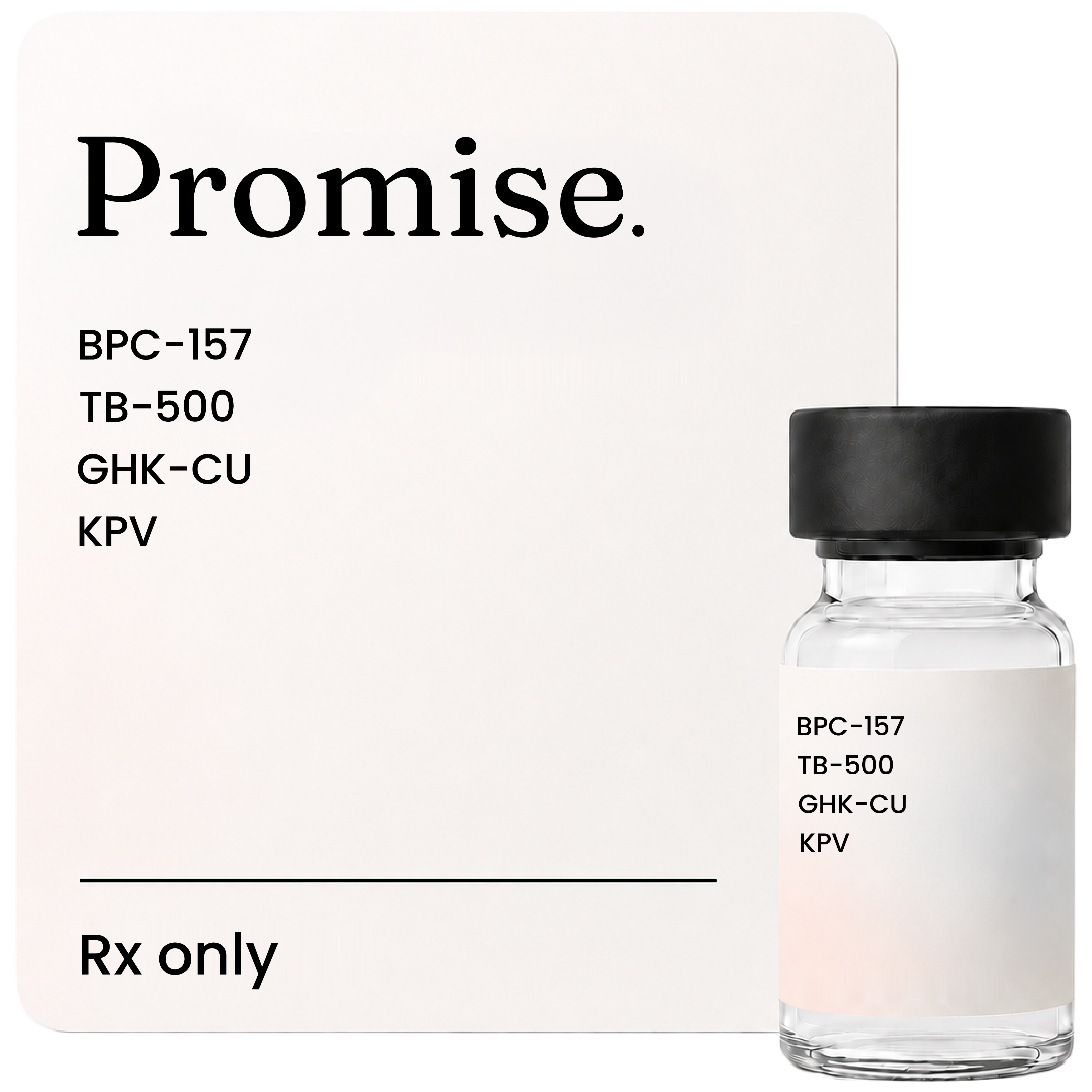
Access boundary. The four-peptide KLOW blend is now prescribed by Promise Peptides; its prescription-only product is listed at mypromise.com. A licensed U.S. clinician considers each person's case before choosing whether to prescribe, and can turn down the request. The service is for patients in the United States; state rules and treatment choices limit the options. The compounded blend has no FDA approval. Prescribing does not fill the gap in controlled blend trials.
KLOW blend: the null reading
Controlled blend trials on record: 0.
Every result on this page is from a single-constituent study. No controlled experiment has co-administered KPV + GHK-Cu + BPC-157 + TB-500 and measured an outcome against monotherapy, any subset, or placebo. The combination rationale is mechanistic — the four pathways address complementary nodes of one cascade — but mechanistic logic is not the same as demonstrated synergy.
Additional constraint: the four peptides have markedly different half-lives and clearance rates (pharmacokinetic mismatch), so a single co-formulated vial cannot hold all four at matched exposures. Which effect is dominant at any given time post-administration is unknown.